Own Up
How it worksAbout
Resources

Learning Center

The know-how you need to navigate home financing.

Explore our learning center

Affordability Calculator

Learn how much home you can afford, and the next steps to take in the process.

Affordability calculator

Rate Range Finder

Get the range of rates for your borrowing scenario across thousands of lenders.

Find your rate range

For Realtors

Learn how Own Up can save your clients time and money.

Learn more

ReviewsFAQ

How to Refinance Your Mortgage Without Paying Any Closing Costs

Written by:  

Patrick Boyaggi

Patrick Boyaggi

Patrick Boyaggi

CEO an Co-Founder

Patrick is the Co-Founder and CEO of Own Up. He has a wealth of experience and knowledge as a mortgage executive.

See full bio

How to Refinance Your Mortgage Without Paying Any Closing Costs

When you refinance your mortgage, you have two choices:

  1. Pay closing costs, which means you will get access to the lowest rate offered by your lender
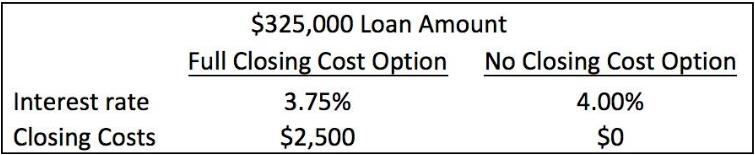
  2. Avoid paying closing costs by getting the lender to give you a credit to cover your closing costs. In exchange for this credit, you will close with a higher interest rate.

With any choice, there are tradeoffs. So, how do you know which scenario to choose? The decision ultimately comes down to how long you think you will keep your mortgage for. If you think you are going to be in the mortgage for a long enough time to recoup the closing costs with the lower monthly payment, then paying the closing costs is a better option.

If you are unsure or you don’t think you will be in the mortgage long enough, then it is better to avoid upfront costs and take the higher interest rate. For historical perspective, the average life of a mortgage is approximately 6 years, so most often the math suggests it is best to avoid paying costs when refinancing.

Here is an example to illustrate the choice using a basic scenario:
Screen Shot 2019-03-24 at 10.36.10 PM

![GET STARTED]

See What You Qualify For

See What You Qualify For

4.98 RATING BY ZILLOW

Disclaimer

The information provided to you in Own Up blog is intended to be for general informational and educational purposes only and does not constitute legal or tax advice. This blog is not a substitute for obtaining legal or tax advice from a qualified professional. The views and opinions expressed on this blog are solely those of the authors and do not necessarily reflect the official policy or position of Own Up or describe Own Up's business model. Own Up makes no representations or warranties of any kind, express or implied, about the completeness, accuracy, reliability, suitability or availability with respect to the blog or the information, products, services, or related graphics contained on the blog for any purpose. Any reliance you place on such information is therefore strictly at your own risk.